Thursday, 15 April 2010

Northern Argentina into Bolivia

Mendoza

Mei writes: We arrived in Mendoza at dawn with the soon-to-be familiar post-nightbus fug in our heads. It’s a clean, modern city and it gave us our first views of the Andes over towards the Chilean border, but it was only really when we got out of the city itself on the second day that we began to understand why everyone raves about the province of Mendoza.

We had organised a day-trip which involved half a day of horsetrekking in the foothills of the Andes and then – controversially for me (Mei) with my fear of water – an hour of white-water rafting. The horses were the most well-trained and docile creatures imaginable so there was no reckless galloping but that didn’t stop me from indulging in my Clint Eastwood fantasies and whistling the tune to “The Good, The Bad and The Ugly”. I still haven’t mastered lighting a match on the soul of my cowboy boots though. As for the rafting, it was only a Level 3 so the water wasn’t particularly white but it provided all the watery thrills that this coward needs. We found ourselves in a raft with four Argentinians (funnily enough!) and in order to row in the correct direction we had to learn three words - “atras”, “adelante” and “halto” - from our guide to ensure that we got merely wet as opposed to getting tossed overboard or crushed on a rock. Next time we’re near a fast-flowing river. I’ll be recklessly discarding life-jackets and looking for a Level 4. As soon as I’ve learnt to swim.

On the topic of the many things that I can’t do, we knew that one of the most popular Mendoza activities is hiring a bike and riding between the many bodegas in Maipu, sampling the local wine. Now I’ve never had any problem drinking, but for some reason – maybe a combination of physical incompetence, sloth and weird childhood – I never learnt to ride a bike. I had come to terms with the idea that on that Monday (which happened to be my birthday), Chrissy would pedal around the vineyards while I walked to the nearest and sit there getting slowly drunk. As it turned out, we met some Americans who had already toured the wineries by bike and one of them was a fellow bike-wobbling freak who had conquered her inability to ride by taking the back seat of a tandem. So when we had accepted a freebie glass of vino from Mr Hugo –the nice man who hires the bikes – we were astonished to discover that, with Chrissy’s vice-like grip on the handlebars, we didn’t fall off. Not even once. Not even after visiting two vineyards, a cerveceria and a place making fruity liqueurs.

The next day we took a 20 hour bus-ride north to Salta, an ancient city with some beautiful colonial buildings and a much greater number of indigenous people than we had seen further south or east in Argentina. Apart from an interesting anthropological museum in Colonia, Uruguay (where, as far as I understand, all of the indigenous people were wiped out) which acknowledged the human cost of colonisation, we hadn’t seen much reference to colonial history. But in Salta and, later Tilcara where the people have erected plaques acclaiming their pride in having resisted European oppression, it suddenly became clear that Argentina is not as “European” as a few days in Buenos Aires might suggest.

We were lucky to have got an amazing deal when buying our bus ticket to Salta which meant that, as Hostelling International members, we could get a free night in Backpackers Home, the HI place in Salta that throws in a free breakfast and dinner for a the equivalent of 9 quid (admittedly in a pokey dorm). The food was decent as well as free and, in an attempt to keep everyone spending in the hostel bar, they even put on a night of the music that is associated with peñas, the folk music bars that seem to be found in the Andean region. Just a guy with a guitar (and an apparently essential large belly) and a guy with a big drum. The songs were tuneful, the clapping expected from the audience was easier than those tricky flamenco rhythms, the beer flowed nicely and a good time was had by all, even when a young Brit was invited up to play a couple of introspective Radiohead and Lenny Cohen tunes.

Tilcara

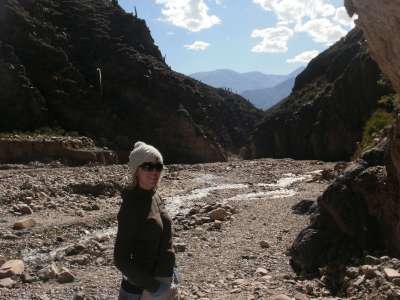
Chrissy writes: Beautiful as the architecture in Salta was, we’d had enough of cities for the time-being and stowed the Rough Guide at the bottom of a backpack for a few days, heading north-east (and up) to a small town called Tilcara. This was good. We spent three days in a peaceful hostel up a hill in the company of owner Juan and some dogs: Labrador Maggie, nameless stinky dog and Sandy dog, who adopted us for one day when we got to do some walks to a Pukara (kind of fortress) that had been restored in the 1950s and to a big canyon and waterfall. Maggie also took Mei on a long walk up a steep hill, where he saw some condors and lost his breath in the 3000-plus altitude. From the markets to the restaurants, Tilcara was also a food-haven: my highlights were corn-based mote salteada, jam made of a local pumpkin, lamb cooked in black beer and scrumptious vegetable and quinoa soups. The food journey did take a nasty side-track when Mei inadvertently ordered a strange version of mondongo, which, despite assurances that it was meatless, consisted mainly of spongy white lumps of tripe.


Bolivia


Crossing the border from sleepy Sunday La Quiaca into Bolivia was relatively painless until we looked into buses out of hectic Villazon and Mei had to run around hell-for-leather changing currencies and nabbing bus tickets for the only departure to Tarija for another seven hours. (This was hard. It seems an altitude of over 3000 metres affects one’s ability to charge around. Our carb- and steak-heavy diets and sedentary recent weeks have nothing to do with it.) Breathing a sigh of relief that we’d got the bus in time, we set off bouncing along a dusty road.

Somewhere further up in the Bolivian Andes stretches a road that professes to be the world’s “most dangerous” where you can pay good money to hurtle down on two wheels precariously close to death for the buzz. Well, I’d like to thank Copa Moya Bus for furnishing us with utter terror for the bargain price of 35 Bolivianos (£3.50) on our transfer from Villazon to Tarija. We have since been informed by a local lady NEVER to take a Copa Moya Bus because of their shocking accident rates.

It was the scariest bus journey of my born days. The road was a system of snaky hair-pin bends, single track and unpaved, prone to becoming impassable in rain. As we descended from about 4000 metres, then climbed up again, clinging to the road, I shut the curtain and deafened myself with music on to the max to stave off death thoughts (and to block out the synthtastic and warbly cumbia music that was causing irreparable damage to the bus speakers above our heads). It was beautiful, when I could scratch up the courage to look. After a long and bumpy seven hours, the city lights of isolated Tarija spread out like a carpet of glitter below us.

Tarija is bustling and pretty; suddenly too, spice, vegetables and fruit are back on the markets and menus, which is exciting news for Mei after weeks of carne-tastic Argentina. We spent a couple of lazy days here and our only excursion beyond the food market and the restaurants has been brief – watching a free piano concert of Bolivian classical music at the Casa Dorada. But it’s been a great couple of days. Not relishing the thought of an 18-hour bus ride north to Sucre, I splashed out 40 quid on a 50-minute flight with TAM, the military airline of Bolivia. I’d like to say that it’s Mei’s enviro-credentials that stopped him getting the plane too, but the tour of a winery around Tarija and the significantly lower price of the bus may take some credit.

Sucre has been fantastic so far - it's chock full of pearly white buildings and stunning views and is vibrant without being hectic. We're staying in a great hostel called La Dolce Vita, where the owners and travellers are uber-friendly and reluctant to move on after weeks and weeks. It's going to be hard to cut the ties and keep heading north. In the meantime, before lassitude sets in completely, we're polishing up our Spanish back at school and I'm helping some Bolivian students with their English. Feel a bit rusty, so after a few weeks they may know such useful subjects as the words and the moves to the hokey cokey and how to play Monopoly.

Friday, 2 April 2010

Northland, NZ; Argentina and Uruguay


Chrissy briefly mentioned the extra week that we spent north of Auckland as a result of the earthquake in Chile and now – three weeks overdue and two countries later – I’ll try to fill in the details. We spent a night feeling guilty about the Chilean airline putting us up in the luxury of Auckland’s Holiday Inn and, as we gorged ourselves on free buffets, we tried to remember the people for whom the earthquake didn’t work out quite so well.

At first, Northland seemed disappointingly crowded (all concepts of crowding in New Zealand being relative). We spent a night across from the undeniably picturesque Bay of Islands in Russell and visited touristy Paihia the next day, but it was only when we went further north that the landscape became as jaw-droppingly beautiful as we had experienced in so many places in the Coromandel and the South Island.

Whangaroa Harbour and the string of beautiful, sandy beaches to its south was the highlight and this was where we first discovered the pleasures of “fishing” for pipis (something that looks like a big cockle and tastes like a meatier mussel). It started when we saw the only other people on Matauri beach (close to the final resting place of the Rainbow Warrior) – two Maori women – standing waist deep in the sea filling carrier bags with shells. With a little instruction, we were soon experts at finding the shells buried just below the surface, pulling them up and filling our own makeshift fishing net. That night, a bit of garlic and onion and the self-righteous pleasure of foraging for free food overcame the gritty half kilo of sand that we consumed along with the fleshy pipis. The next night, in Ahipara at the southernmost tip of Ninety Mile Beach (which, as you may have guessed, is a long stretch of sand), we were taught that the key to removing the sand is to let them soak overnight so we went out and caught us our lunch for the following day.

Part of the pleasure of these last few days in New Zealand derived from the lovely places that we stayed in. Brent’s tent had been returned to him, our Wicked days in a camper van were behind us and so we had the luxury of staying in beds under roofs. Even though we were still sticking to a tight budget, “backpacker” accommodation is so good in New Zealand that in our last three days we encountered hammocks, hot tubs and a “tree house” in a forest near Kohukohu planted by Mr and Mrs Evans, a pair of Aussie environmentalists, whose love of trees and birds was infectious.

As may be obvious, I love New Zealand. It’s the most beautiful country I’ve ever seen with the friendliest, most laid-back inhabitants in the (English-speaking) world (in my, admittedly, limited experience). I could go on about Kiwis (the people) for pages but I love the way that so many of them love their environment as well as their nation and I’ll leave it at that. As for the original kiwis, we went on a night “trek” in a group of about twelve on our last night and we heard their eerie calls several times in the dark forest. Unluckily (for us) we were at the back of our little platoon of kiwi hunters and those at the front saw one about ten metres away but by the time we knew what their excited whispers meant, the timid bundle of fluff had scuttled off.

Kia ora (which now means more to me than just a sugary drink from the eighties).

Buenos Aires & Uruguay

The heat and hustle that met us as we left Buenos Aires couldn’t have been more of a contrast to the “sweet as” welcome that we got when we touched down three months earlier in New Zealand, but at least it helped to prepare us for what was to come. Having learnt the extent of how literally taxi drivers in Vietnam interpret the phrase “time is money”, I wasn’t as shocked as Chrissy by the speed or disregard for human life of the guy who drove us to our hostel, but it would be dishonest of me to claim that I wasn’t relieved to find in my rucksack some clean underwear when we arrived.

It’s hard to describe Buenos Aires in a paragraph. It would be like trying to cram a sleeping bag into a matchbox. But here goes. It’s big. It’s dirty. It seems to have more restaurants in a square mile than there are in the whole of Wales. The underground trains are crowded, sweaty but cheap as chips (and steak). Wherever you get off the subte (underground) or bus at whatever time of day or night, crowds of people seem to be rushing somewhere. It makes London seem quiet.

So how come, if it’s so horrible, did we ended up staying a fortnight? Well, after the initial shock, it’s actually great fun. Even though we took no photos, here are a few personal highlights. Hearing my favourite tango tune (“Libertango”) played on a bandoneon by a busker on a train. Paying about 4 quid for one of the nicest bottles of wine I’ve ever tasted in one of the nicest restaurants I’ve been to. Here I will allow Chrissy to describe the flavour of Argentine (and Uruguyan steaks).... texture, first. You could cut them with a spoon, they’re so soft. Then it’s all juice and succulence (describing a steak this way is actually sounding a bit pervy, so I’ll hand back to Mei)...

Oooh, matron! Anyway..more highlights: many of them musical: La Bomba de Tiempo, a stunning improvised percussion group that turn Konex (an arty gig venue) into a heaving festival every Monday night with their intricate, danceable rhythms enhanced with thumb-piano, trumpet and bass guitar. A neo-tango band, Orquestra Tipica Fernandez Fierro, who turn bandoneons (those big accordions) into something cooler and sexier than a Fender Stratocaster. Oh and we had tango lessons at a milonga where I became a graceful dancer (until my dance partner slapped me and I woke up).

A walking tour of the city with a couple of local students helped us to understand some of the political history of this place. After the tour we saw the “madres” of the political dissidents who were “disappeared” by the military fascists of the seventies march around Plaza de Mayo and, although it feels voyeuristic to be a tourist watching this display of public grief and defiance, it was incredibly powerful to hear the names of the dead read out in a roll-call and to hear the crowd shout “Presente”.

So, yeah, the city worked its charm on us and we stayed an extra week to attend intensive Spanish classes which have enabled us, at least, to say “Mas despacio” (“more slowly”) when people speak to us. I should point out here that our stay in Buenos Aires wouldn’t have been half as much fun if we hadn’t enjoyed the hospitality and advice of Clemmy and Ed (as well as Emma). Cheers.

After two weeks we went by train to the Tigre delta where we spent a night with two other guests in the biggest emptiest hostel in the world (like the setting for a low-budget version of “The Shining”). Then across the Rio Plata to Uruguay. I’m writing this six days later on the boat back and I can’t say that I got much of a sense of what makes Uruguay distinct. We spent two nights each in Colonia del Sacramente, a historically significant town which bore the brunt of struggles between Brasil and Argentina, the local big boys. We bumped into Nicole, a lovely Spanish student from our classes in Bs As, and her friend, Alyona, there so we spent the day disturbing the town’s peace by riding around in a hired golf buggy and a go-kart. That night we had a meal in a restaurant where the free entertainment was a couple of local guys playing “flamenco-fusion” on their Spanish guitars. Sounds cheesy but they were brilliant.

Then, we headed east to the Atlantic coast to Punte del Diablo, a kind of surfers shanty-resort where we let our hair grow for a couple of nights and hugged some ombue trees unique to the area before heading back to Montevideo. Montevideo seems to be a lively city in the daytime during the working week. We, however, visited on the weekend. We met some really nice people there though, and Uruguyans seem as friendly as Argentines and maybe a bit more chilled.

Our return to Argentina took us on an overnight bus from Buenos Aires to Cordoba, a city full of bookshops, bars and universities. The first things we had heard about travelling in Argentina invariably referred to the quality of the buses. We had been told of seats that folded back to become beds, TVs, free wine, meals and even whisky. In my mind (always a bit susceptible to fanciful exaggeration), Argentine coaches had become palaces of the highway, mobile Hiltons complete with a bottle of Bollinger on departure. Sadly, reality rarely lives up to expectations and I was disappointed that the stewardess didn’t even offer a footrub, let alone the full body massage I was anticipating.

Cordoba was pretty but it was hot and we realised that what we were missing was countryside, so we came here to a tiny pretty town of Mina Clavero in the Traslasierras region south of the city. Here, we’ve been forced to improve our pidgin Spanish and relax in the sun by a river. Tonight, we’re on the night bus to Mendoza, wine country.

Wednesday, 3 March 2010

On our return to Wellington, we were lucky enough to get our hands on tickets to the Wellington Rugby Sevens (thanks, Brent!). The Wellington Sevens. It’s rugby, Jim, but not as we know it. This is how I (Chrissy) understand what we witnessed: Once upon a time, some bright spark took a look at rugby, which is, let’s face it, dull and complicated. He decided to kick a few players off the pitch but, ye gods, it was even duller. What to do? Said bright spark noticed that no-one was watching. Well, I’m not going to insinuate that all alpha males are closet cross-dressers, but when the concept of fancy dress was introduced and all the men were actively encouraged to dress as women, viewing figures escalated. Well, the rugby-widow demographic were pleased no end because they could laugh at their menfolk and ignore what was going on pitchside (just like everyone else). Add lots and lots of cold beer warmed in the January sun and it was carnival, New Zealand-style.

As for our own costumes, the chaps were far too manly to don a Wonderwoman or Bruno outfit, so we went as a lounge suite (naturally). Mei had been getting over-excited about the whole rugbiness of the event for weeks, so when he discovered that I would be dressed as a bookcase, he spent a whole day feverishly wracking his underused brain for hilarious and topical imaginary rugby-related book-titles to write on the spines of the books which adorned my smock/bookshelf. If you care more than ten-thousand rugby fans, have a gander.

From Wellington, we headed up the East Coast to art-deco Napier, intent on getting our architecture fix. Helpfully, this is also prime wine country and the lack of photos attests to our dubious priorities. We managed to drum up enough sobriety for a long, early-morning (tide-dependent) rocky beach walk to a gannet colony; even the locals choose to go by tractor rather than walk. Now we know why.

From here, we lost a few days on a stunning beach north of Napier which may be called Wapatiki, finally heading inland to Taupo and soon enough, down to a great campsite at tiny Tokaanu. We loved the geothermal and spa pools here and, like many of the places we’ve been to, find it hard to pinpoint why it was such a great place to stay. Something, definitely to do with the generosity of our hosts. In the space of two days, they gave us milk, a trout, cakes, a towel and offered us (admittedly whilst drunk) unlimited access to their beer fridge. Or maybe it was the softness of the grass that made the place so special. This is important when camping without a mallet, we’ve discovered.

From here we walked the Tongariro Crossing, New Zealand’s best one-day hike, which really lived up to the hype - emerald lakes, volcanoes and sweeping views all the way across to Mount Taranaki. If there are no photos of staple tourist favourites Taupo or Rotorua (that we also visited along the way), this is probably because nothing could quite live up to Tongariro. It may also because tourists are lured to Taupo and Rotorua so that Kiwis can keep all of the truly gorgeous places uncluttered. We did, however, stumble across a lovely open hot spring pool during a riverside walk from the tiny but stunningly white Huka Falls near Taupo.

Rotorua is a good place to get a sense of Maori cultural tradition and to eat some tasty sashimi, but our true aim in visiting the town was an anthropological quest which reached its climax while camping at a hostel here. We had heard rumours that an incredibly rare and endangered species, the Inhospitable, Hostile Kiwi could be found somewhere in the North Island (although its existence is threatened by the Chillaxed, Welcoming strain). Suffice to say that the hostel owner fell into this endangered category, and we feel obliged to say that tourists should avoid at all costs disturbing the hostel owner in its natural habitat.

We’re even worse at planning than we are at reading maps so, having crossed diagonally from Wellington up to Hawkes Bay in the north east, we decided it was time to return south west again to see the glow worm caves in Waitomo. It’s a tourist cliché in New Zealand to go there, but it was surprisingly crowd-free and beautiful, both above and below the ground. We stayed in a proper bed in Waitomo, well a bunkbed at least, and the presence of a ceiling rather than mozzie-infested canvas above our heads gave us a taste for more of the same. Chrissy has relatives in Taranaki (home of Brent and Jermaine of Conchords fame) who have a dairy farm so we paid them a visit, and when they (Bronwen and Jim) offered us the option to stay indoors, we grasped it in our grubby hands (the grubbiness due to a messy introduction to the fine art of milking). Apparently cows are incredibly placid as long as their usual routine is maintained, but if you introduce a wild card - in the form, for example, of a couple of townie Poms - bombs away! They (whoever “they” are) say that what doesn’t kill you makes you stronger so thank you, Jim and Bronwen, for making us stronger (if smellier) and for making us so welcome.

Our haphazard grasp of geography took us next to West-coast surfie mecca Raglan and then eastwards to the Coromandel Peninsula. Waihi and Oputere beaches set the tone for the rest of the peninsula – white expanses, few other people and pounding blue surf. The highlight of this region had to be our time in and around Hahei, which is a neighbouring beach to Cathedral Cove, where we walked and snorkelled. No highlight is complete without alcohol, however, and we loved spending a few drunken hours in the company of the Evans family at Purangi Winery. We were introduced to the merits of feijoa and plum liqueurs before finally settling a gert big bottle of lemon gin. The next few days were a haze of beaches, sun and merry spilling of tonic.

A few rudimentary days were spent in the lovely City Garden Lodge in Auckland, before we were due to fly to Santiago on the 28th. If you’ve read or watched the news (we hadn’t), you’ll know about the earthquake in Chile on the 27th. We felt pretty relieved that we hadn’t flown out a day earlier. LAN Chile airline put a few straggling travellers and plenty of worried Chileans up in the Holiday Inn for the night. The flight was back on the next day, but by this time we’d been advised to change our plans, so we managed to get on a flight to Buenos Aires on the 8th March.
So, the last few days have been part of a stolen week in Northland, NZ, where the sun is still shining, the campsites are ghost towns and where you can dig out pipis (little cockles) from the sand for your dinner.

Friday, 12 February 2010

South Island

Meirion wrestles control of the keyboard and writes:

Someone said that history is written by the victors, and I’m sure that’s true and terribly clever, but it seems that travel blogs are (usually) written by the person who’s not doing all the proper work, like driving campervans, brewing hot, malty drinks or making sure that the towel is weighed down neatly and securely on the beach while the glamorous half of the operation swims with seals and such.

So yeah, anyway, what I’m trying to say is someone needs to tell the other half of this blog. I had a look at what Chrissy wrote in the last two episodes, and while I admit that I had an editorial role and am happy to take credit for any amusing bits, there are some pretty glaring omissions in her account.

So, yes, it’s true that we went to the Catlins and yes, the wind truly did blow harder than a hard, blowy thing. But so much more happened than that. For example, her title’s reference to the Catlins as “Deliverance country” was taken from a sign at a place we stopped called the Lost Gypsy Gallery in a tiny one-mule town called Papatowai. Inside a tiny caravan, an inventive genius who must have inherited the DNA of Heath Robinson had created all kinds of solar-powered automata that gave us (and any others who had the good fortune to stop in search of toilets or whatever)hours of amusement. Of course, you really need to visit to see how much fun it is and we tried to insert a little video of Chrissy playing a bizarre organ but you'll have to come to our place in the summer to see our slide show because it won't upload.

Loads of people describe the Catlins as “remote” as if there’s anywhere in New Zealand that is “central”, but the truth is it’s bloomin’ gorgeous (like most of the country) and if someone would simply sort out that wind issue they have down there, it’d be teeming with tourists. Curio Bay, where we stayed for one deafeningly blowy night, has dolphins, penguins, sea lions, surfing and stuff. It even has a petrified forest (as seen in one photo) instead of conventional rocks as part of the coastline/ seafloor. This has something to do with the trees being preserved in volcanic ash but I’m sure that Wikipedia can fill in the rest of the details.

In case Chrissy forgot to mention the Moeraki Boulders in her previous blog, they are the spherical rocks stranded on the beach in another pic. Crazy geologists would love to brainwash us with fanciful stories of tidal erosion or some such nonsense, but any fool can see that they are clearly the ancient, fossilized remains of passenger pods from alien spacecraft.

And the simple explanation for why the aliens left so quickly can be seen not far away on the south coast: they visited Invercargill!

So, from Invercargill - a town that looks even worse in the sunshine because you can see it so much more clearly – we went west through yet more stunning Alpine countryside to Fiordland. We decided to stop in Manapouri (on the shores of the lake of the same name) and not even the hordes of savagely hungry sandflies could detract from the beauty of the place. We wanted to visit one of the fiords and the lovely old American lady who ran a lovely old campsite advised us against an all-day kayak trip, persuading us to do an overnight trip to Doubtful Sound instead. Having taken one look at our scrawny yet portly bodies, she had decided that the half hour of kayaking on the fiord included in the overnight trip would be plenty.

She was so right. As a non-swimmer I frantically paddled, trying to stay afloat (forgetting that frantic actions are the enemy of flotation) occasionally glancing across at Chrissy who, tormented by flies intent on sucking her blood, had given up rowing and was adrift, mid-fiord, swatting at insects, some real but even more imaginary. As it turned out, my fear of water outweighed my fear of air-borne parasites and the huge gouges that had been gnawed from my ankles only became apparent when we returned to the safety of the” mothership”.

Fortunately, it was not only the sandflies that feasted well that day. The real attraction of the trip was not the kayaking or the beautiful scenery (see the photo); the trip was sold to us the moment Chrissy heard camp-site lady mention the words “roast beef” and “salmon”. After a few days of eating carrots and tomatoes from the back of our campervan, any trip involving a three-course meal appealed to us like rumours of gold attracted settlers to Otago in the nineteenth century. In fact, if she had offered us a bungee-jump into an open sewer, we would have snapped it up if there had been nice food at the end of it.

On from the fjords to Queenstown (briefly). Every tourist in New Zealand else goes there so we did too. For half an hour. After days of tranquillity, arriving in a place full of cars just felt wrong, so we headed up the road to Arrowtown (an old gold-mining town where buildings of the community formed by Chinese labourers still stand). More importantly (for us at least), it has a cinema where you can watch a movie from the comfort of the battered old armchairs and sofas that accommodate a maximum audience of fifty. Just what you need when it’s raining.


Wanaka was next, and it’s one of the loveliest places in the world. We parked our van outside the house where Chrissy’s lovely friend Sarah lives with her lovely friends and their regular (and usually lovely) couch-surfing visitors. The sun was out, the lake sparkled, the mountains loomed, the tramping was beautiful and the wineries let us taste their wares. What more could we ask? The pictures are of a stunning tramp (i.e.walk) that we took to see Rob Roy Glacier and of a plane-trip that Chrissy and Sarah went on to see Milford Sound from above.


From there, we drove to the west coast, stopping briefly at a lakeside layby where we bumped (by random) into someone riding a tandem that Chrissy had been to Uni with. Oh, and the tandem bit is true; I didn’t add it just to rhyme with random. The plan was to walk on a glacier, so that’s what we did, spending a few hours crunching around on crampons on Fox Glacier. That explains the photo where we are surrounded by ice.

By this point we were running out of van hire time, so even though the west coast was stunningly green and picturesque, we headed towards Arthur’s Pass (one of the routes through the hills back east). We tramped up a mountain called Avalanche that nearly killed us; in retrospect perhaps we should have paid more attention to the name. The peak was home to a trio of keas (intelligent and “playful” alpine parrots that are famous for pestering humans) who seemed to have calculated that hungry walkers reached the top with their sarnies, apples and muesli bars every lunchtime. Unfortunately their intelligence doesn’t extend to an awareness that what is food to humans is poison to them. We managed not to let them pinch any of our grub, and it was nice not to poison the cheeky little beggars, but it was even nicer to fill our rumbling bellies.

Then to Christchurch where we did city stuff (like a brilliant Joanna Newsome gig) before returning to North Island.

Sunday, 17 January 2010

Catlins: Deliverance country

New Zealanders know a lot about weather. I thought we had that covered pretty well, but no. They KNOW weather. Apparently, as we're told frequenty, we're suffering the knock-on effects of El Nino here, which means cloud cover and rain for forseeable. Much like British summer.

We've spent a few lovely days in the Catlins, which seems to assume almost legendary proportions amongst any New Zealanders we spoke to along the way, probably because it's pretty remote and some section of the roads are unsealed. The highlight has to be Curio Bay, where we saw a petrified forest, some wee penguins and two rotund sea lions and some amazing bay views. Photos to come when technology blesses me again.

Stuck for an hour in Invercargill for resupplying. It's Milton Keynes, but bigger.

Monday, 11 January 2010

Four seasons in one day


Wandering in transit around Sydney Airport after a long haul from Heathrow (to be closed a few days later... thank you for my passage, weathergods!), I was buoyant to see Mei appear, looking as tanned as a Welsh boy can be. Brief reunion enjoyed by both, but the joy was acorn-sized in comparison to the oak tree of excitement when Mei said “There’s someone famous behind you.” Looked around to see Martin Johnson – hero to all English rugby fans but arch-enemy of the likes of Mei - also in transit with us. Tried to get surreptitious photo to send to Hello! but Johnson’s brow furrowed in a menacing way. Photo untaken.

A couple of flights later and after numerous comparisons of arm colour that confirmed I was a few tones bluer than milk, we arrived in Wellington. Fantastic Christmas hosted by the Spicer clan in the warmth of summer. If I felt any initial bemusement by the lack of snow, trees and general rigmarole of British Christmas, this was soon dispelled by a gert big three-meat Christmas spread and the regular appearance of the sun.

From here, we went en masse with handfuls of Spicers, Attenboroughs, and a Waesenbach, down to Kaiteriteri, in the Abel Tasman National Park. Even the photos taken on my pink Argos camera manage to capture how beautiful this area is. Most of the park is only accessible by foot or boat, hence on our walks we had our pick of pristine white beaches with turquoise waters and next to no-one there. Another afternoon we went horseriding along the beach, mentored by the wise words of the guide,Harmony (that’s him - far left- on the phone, dispensing some advice to another punter). New Year was seen in with my bro and my sis (a first since the days when we were too young to know better, I think?!) watching Fat Freddy do his Drop in nearby Riwaka. Good drunken revelry.

There’s a lot of water in New Zealand, so we had lots of fun on boats here, and back in Picton, where we began our venture as a duo. We went on a dolphin watching expedition with a 98% success rate. Suffice it to say we were in the 2% of failures. The sales pitch that day was that orcas (“killer whales”) had been spotted that morning. What they didn’t tell us until we were already on board was that if we didn’t see the orcas, then we’d see no dolphins cos the killers scare them all off. A consolation prize was that we did see king shags (stop sniggering at the back!) which, according to the skipper, are some of the rarest birds in the world (or New Zealand, or somewhere). To us they just looked like big seagulls, but maybe some ornithologist somewhere will be impressed when we tell them. Despite a lack of sea mammals, the boat trip gave us beautiful views of the Marlborough Sounds, a visit to an island bird sanctuary where we saw little blue penguins nesting and plenty of sunburn.

A bus took us down the East coast to Kaikoura, where I got back in the water, encased in wetsuit, to swim with seals. They are brilliant! Really inquisitive. The guide told the swimmers to mimic what the seal pups were doing, as they like to interact with you, so I did try to duck and dive, but....if they look rotund and beached on land, they move like the dickens in water! I really loved this morning trip though and got really burnt on my face. Again.

From here we spent a couple of aimless but pleasant days in the garden city of Christchurch before picking up our hideous transport, which garners us plenty of tutting and narrowing of eyes from more well-heeled campers. If you can’t quite read the sign, know that it’s part of the Wicked ‘philosophy’, which seems to be plastered all over (and inside) the van. Still, it’s cheap and relatively cheerful, and has powered us slowly to the Banks Peninsula, where we’ve spent a brilliant and varied few days, stopping at an old friend of Mei’s for the night in Little River.

Nuff blathering. We’re southward bound now and it’s raining, much like a British summer. Four seasons in one day and all that.

xx