Our stay in Sucre lasted a week (the longest of anywhere since Buenos Aires). The city was beautiful with its whitewashed colonial buildings, life was genuinely sweet in La Dolce Vita Hostel and we met some of the nicest people of our journey so far. We never got around to helping out with the locals’ English lessons but the Spanish teachers at Fenix were brilliant. We both managed to get a little bit ill but there were plenty of highlights including a game of Wallyball (a cross between squash and volleyball), lots of games of Yenith and the funniest karaoke night ever (which is, I admit, a bit like claiming to have met the nicest Nazi ever!)
Eventually the time came to move on, and we decided to head towards the salt flats in Uyuni (which, like most things in Bolivia, are the highest, biggest etc in the world). We decided to get there via Potosi (the highest city in the world, allegedly). Potosi cowers at the foot of Cerro Rico (Mountain of Riches) where the conquistadors discovered gold and minerals of enormous value which helped them to control the locals almost as much as guns did. There are still mines inside the mountain where people work with a maximum life expectancy of reaching forty (which would have made me, to paraphrase Monty Python’s parrot sketch, an ex-miner if I had been unfortunate enough to be born poor in Bolivia). Nowadays tourists like us can go down into the mine and watch the miners as they breathe in the toxic fumes, which strikes me as being a bit like wanting to get in a time machine to see how slavery worked. We had been told by some people that Potosi isn’t worth visiting unless you go down the mine but, as we didn’t go down, we still can’t comment on whether it’s worth a visit. Suffice it to say we moved on the next day with a kid of about ten singing songs on the bus in the hope of earning a fe w pennies - it may be begging, but I guess it might just keep him out of the mine. And alive.
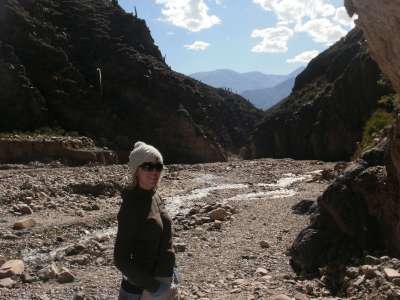
There were road blocks in south western Bolivia (apparently due to protests at a Japanese mining company being allowed to steal most of the regions’ water) so we were unable to see the lagoon which contains thousands of pink flamingos (poor us!) but beyond the train cemetary at the edge of the town, the salt flats were an amazing, surreal landscape, and we saw a few flamingos too (lucky us!). Uyuni is unlike anywhere I've ever been and even the Argos princess managed to capture some of the eerieness of the place( below). Obligatory silly photos taken, we moved on to our next destination: La Paz.


Next we wanted to get to Madidi which is in the Bolivian section of the Amazonian rainforest, but we knew we would have to go via La Paz, which I expected to hate, but which turned out to be beautiful, in its hideously hectic way. Our Argos camera was never going to be able to do justice to the city with its sheer walls of brown mud-brick houses built into the mountain-sides. In the evening, the windows of the houses lucky enough to have electric lights sparkle like the stars that seem just inches above them, and in the daytime, they reflect the sunshine that spills down from the snow-capped mountains of the Cordillera Real.
Blimey! I came over all lyrical for a moment there. God knows what will happen when I get onto the jungle? Let’s see...


I know that it’s a selfish vanity to want to go to an ecologically delicate place like the Amazon just to see some animals and take a few pics, but what’s a world tour if not a huge self-indulgence? So, from La Paz we indulged ourselves in a 3-night trip to the Amazonian jungle via Rurrenbaque. We agonised over which tour company to use – should we save money or pay more for better eco-credentials and a clearer conscience? In the end, we opted for Madidi Travel, an organisation that was set up by the woman who had originally rescued the Madidi rainforest from “developers”. She had set up the park in a beautiful area of forest containing jaguars, puma, several species of monkey and flocks of tropical birdlife. The park also has natural lakes full of caiman alligators and piranha.

Our track record for animal-spotting was pretty poor; maybe it’s our smell but whenever we go to a spot famous for its wildlife, the critters seem to hide, but we did manage to have an amazing time, even if we were never present whenever the other gringos at the park saw families of monkeys. We saw lots of spiders, insects, snakes, a variety of beautiful birds and a few capuchin monkeys. We also befriended a small spider monkey called Chupila 
who had been temporarily adopted by the park when her mother had been killed by hunters. Almost more impressive than the sightings of animals were the sounds of the jungle. The eeriest noise was the song of the howler monkeys which sounds like a dozen hot-air balloons being inflated. Apparently, they’re only small creatures, but they have a big voice-box and they’re not afraid to use it. Our diet was interesting too. As well as the more conventional meals provided, we were treated to termites (which taste like minty-pine sap) and a fat white firefly larva that our guide (Alex) found inside a fruit stone. It was like biting into a tiny sausage containing a milky fluid. Yum!

Coming back to a cold La Paz night by plane, we headed off in a minivan towards Sorata, 4 hours north of the capital. A protest group had set up a blockade along the main road out, which meant we had to navigate the bogs and rocky suburbian dirt track of El Alto, getting out to push the bus when the way proved too tough. The suburban landscape was as close to hell on earth as anywhere I’ve ever seen. Half-built, adobe huts with goats and sheep tethered to the ground trying to find a blade of grass amongst the rubble. Our minibus driver didn’t seem the most competent, and when he stalled the van for the second time, one of the more Alpha male passengers muscled him out of the drivers’ seat and took the steering wheel for most of the five hour journey into the mountains of the Cordillera Real.
 Sorata was described by the conquistadors as the garden of Eden when they arrived in South America, and it probably hasn’t changed much. It’s a quiet little town (apart from the constant shouts of “La Paz! La Paz!” from the bus drivers touting for passengers in the main square) nestled amidst the greenest mountains we had seen since leaving New Zealand. On the bus we had met Tomas, an archaeologist from Sorata, who looked like a cross between Lee Scratch Perry and Haile Sellasie and who decided to befriend us for the duration of our short stay in the town. He spoke even less English than we speak Spanish and most of his conversation revolved around his discoveries of ancient artefacts around Sorata. He seemed to have a theory that the pre-Incan Tiwanaku civilisation had extended much further than generally accepted, but our limited knowledge of archaeology and Spanish made it difficult to establish whether he was a genius or a nutter. Anyway, we had a lovely couple of days there and walked in the beautiful hills to the local cave (where a funny little man took us on a pedalo on the underground lake) before moving on to Copacabana (the one on the shores of Lake Titicaca not the one where music and passion are always the fashion).
The bus journey to Copacabana was unglamorous enough to warn us that this was probably not going to be the place that Barry Manilow had been thinking of. We had to jump off the La Paz bound coach and flag down one that was heading towards Copacabana. The driver stopped but told us the bus was full so we could pay the fare if we were happy to stand. So we stood nearly all the way, doing a little aisle jig to the mixture of cumbia, pan-pipe fluff and Latin cheese-rock that blared through the bus’s blown speakers.
Copacabana is on the shores of Lake Titicaca and most of the gringo travellers pass through on their way to  Peru taking a boat trip to Isla del Sol where the Incas (and the Tiwinaku culture before them) believed that the sun and moon were created. The town itself didn’t seem to have much going for it initially, with its endless stalls selling llama hats, scarves and jumpers and with its back-to-back cafes proudly proclaiming endorsements from Lonely Planet. But we happened to be arriving in time for a saint’s day fiesta and the grubby town would soon transform itself into an extravaganza of crazy carnival costumes, jazzy brass band music and some of the grooviest line-dancing outside of Texas. And then there was the alcohol! We found ourselves adopted by a group of shimmying dancers replete with brass band who appeared to have not made the grade for the main procession, but who made up for what they lacked in style with their impressive fireworks display, their hot ‘whiskey’ that they insisted was ‘pure’ and ‘healthy’ (who were we to argue?) and their warmest of welco
 mes to two uncoordinated gringos. They tried to insist that we stayed up all night but we had already bought our bus tickets. We made lots of heart-thumping gestures and slurred avowals that hopefully sounded something like, “Mi corazon es siempre en Bolivia!” and told lies about how we’d meet back up with them for more dancing at dawn just so that we’d be able to get some sleep before the journey to Peru. It took us until our last night to see Bolivians letting their hair down, and they seem to take their pleasure as seriously as they take everything else.
Writing this several days later now, I realise what a special country Bolivia is. Here, in Peru, the “western world” has been fully embraced with our tight jeans and our willingness to smile at strangers (as long as they are potential customers), but Bolivia is still another world, and I wish we had taken loads of photos of cholitas (the traditionally dressed ladies) to remind us of it. At every road block and every toll booth, alongside every rubble wall with political graffiti proclaiming things like “Mas Evo”, there would be half a dozen old ladies desperately trying to make a living selling chewing gum or fizzy drinks. They never looked particularly happy, but they managed to raise something closer to a smile than I could if I was in their position.